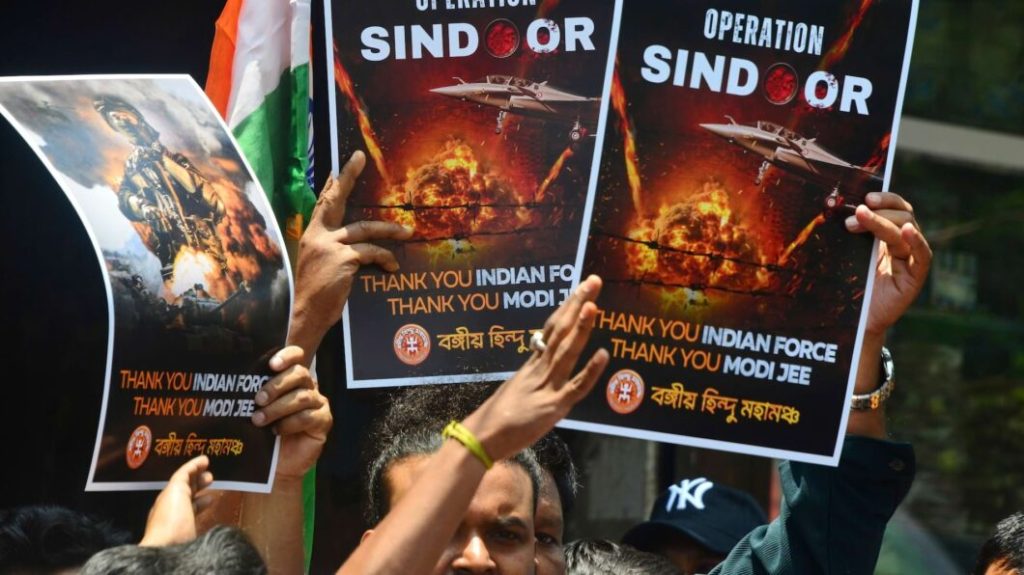
Demonstrators wave posters and the Indian flag in support of missile strikes against targets in Pakistan-controlled Kashmir
Ceasefire or Crisis Deferred? The Rising Costs and Risks of India-Pakistan’s “New Normal”
After four days of intense cross-border hostilities, India and Pakistan announced a “ceasefire-like understanding” on May 10, ending their most dangerous confrontation in years. Both New Delhi and Islamabad quickly claimed victory, but beyond the political posturing, the conflict exposed just how fragile peace is in South Asia—and how perilously close the two nuclear-armed neighbors came to the brink of war once again.
While the ceasefire has brought temporary calm, the costs on both sides—especially along the Line of Control (LoC) in Jammu and Kashmir—have been profound. Civilians were killed or displaced, infrastructure was damaged, and fears of full-scale war loomed large. The episode also highlighted growing concerns around a dangerous new dynamic in India-Pakistan relations: the normalization of military retaliation in response to terrorism.
A Familiar Playbook with Escalating Consequences
The immediate cause of the conflict was a deadly terrorist attack on April 22 in Pahalgam, in Indian-administered Jammu and Kashmir, where 26 Indian nationals—mostly tourists—were killed. India swiftly blamed Pakistan for harboring groups like Lashkar-e-Taiba and Jaish-e-Mohammed and responded on May 7 with nine missile strikes on targets in Pakistan-controlled Kashmir and mainland Pakistan. The strikes escalated into a series of tit-for-tat drone attacks and shelling, dragging both nations to the edge of conventional war.
This wasn’t a one-off escalation. In fact, it was the third time since 2016 that India launched military operations across the border in response to a terror attack. The 2016 surgical strikes after the Uri base attack, and the 2019 Balakot airstrikes following the Pulwama suicide bombing, marked earlier phases of what Indian policymakers now call a “new normal”: the use of conventional military force to deter cross-border terrorism.
But what’s new this time is not the policy itself—it’s the scale and intensity of the confrontation. With drones, long-range missiles, and deep-target strikes, both nations demonstrated not only increased military capabilities but also heightened willingness to use them. Each successive clash raises the threshold for future confrontations, setting a precedent for even more forceful retaliation.
Deterrence or Escalation Trap?
The core problem with India’s “new normal” strategy is its questionable effectiveness. Despite high-profile military actions in 2016, 2019, and now 2025, terrorist attacks on Indian soil continue. Far from deterring Pakistan-based groups, each strike seems to invite the next, dragging the two countries into an ever-tightening escalation spiral.
This pattern creates what analysts call a “commitment trap.” With every retaliatory action celebrated domestically, Indian leaders are left with little political room to explore alternatives. Anything less than a military response in the future could be painted as weakness—especially in the current political climate where nationalist rhetoric often dominates discourse.
Perhaps even more dangerously, India’s commitment to military retaliation gives extraordinary power to non-state actors. Any militant with a gun now has the capacity to spark a regional crisis by provoking a military response from a nuclear-armed state. This fundamentally destabilizes decision-making, placing immense power in the hands of extremists while eroding traditional control by state actors.
Diplomatic Options, Abandoned
The Modi government’s approach also risks sidelining the broader toolkit available for fighting terrorism. In earlier incidents, Indian governments successfully applied diplomatic and financial pressure on Pakistan. After the 2001 Parliament attack, Prime Minister Vajpayee mobilized troops without initiating war, prompting then-Pakistani President Musharraf to take visible steps against extremism. In 2008, following the Mumbai attacks, the UPA government pushed for joint investigations and used international platforms like the Financial Action Task Force (FATF) to isolate Pakistan diplomatically.
This time, however, New Delhi’s non-military response was limited to suspending visas, closing border trade, and even threatening the Indus Waters Treaty—a legally binding agreement. Such moves carry significant humanitarian and diplomatic costs, but offer little tangible gain. Major international players like the EU, Russia, and many in the Global South condemned the Pahalgam attacks but refrained from endorsing India’s military strikes.
Lack of Domestic Accountability
Another troubling consequence of the military-first approach is the erosion of internal accountability. With public attention focused on retaliatory strikes, critical questions about domestic intelligence failures remain unanswered. How did such a large-scale attack occur despite heightened security in Jammu and Kashmir, especially just a week after Home Minister Amit Shah’s visit? These unanswered questions mirror the silence that followed previous attacks in Uri and Pulwama.
By shifting focus outward—blaming Pakistan exclusively—India avoids the difficult introspection needed to strengthen its internal counterterrorism mechanisms. As political leaders bask in patriotic fervor, the need for serious reforms in intelligence, policing, and community engagement goes overlooked.
Fallout for Kashmir and Beyond
Perhaps the most tragic consequence of this “new normal” is its human cost—especially in Kashmir. The border shelling disproportionately affects Kashmiri civilians, who already bear the weight of prolonged militarization and sectarian tension. Since the Pahalgam attack, hate crimes against Kashmiri Muslims have surged across India, adding to their marginalization.
For Pakistan too, the situation is precarious. Its own efforts to deal with terrorism, especially from the Tehreek-e-Taliban Pakistan (TTP) in Afghanistan, mirror India’s frustrations. Pakistan’s military strikes in Afghan territory have not succeeded in curbing violence and have strained relations with Kabul. But unlike Afghanistan, India is a military and nuclear peer. A single miscalculation between India and Pakistan could result in catastrophic consequences.
A Tenuous Peace, An Uncertain Future
In the end, the recent conflict was defused not by the strategic wisdom of either side, but by external mediation—particularly by the U.S. and Saudi Arabia. As the threshold for military action lowers, the next crisis could be even more volatile. And as global powers turn inward or reassess their roles in South Asia, the reliability of future mediation becomes uncertain.
What is clear, however, is that both nations have upped the stakes without securing commensurate gains. Unless India and Pakistan both recalibrate their strategies to include diplomatic, economic, and internal reform tools, future conflicts will only become more destructive—and less controllable.
The “new normal” may be militarily satisfying in the short term, but it is no substitute for a comprehensive counterterrorism and peace-building strategy. The road ahead demands more than missiles—it demands restraint, reform, and, above all, responsibility.
 Jurist's Journal
Leave a comment